

The Pietà
—and the Power of Art

A subscriber shared his Pietà experience:
“Ayn Rand was a genius. And while I didn’t know how to think about reality (or thinking itself) until I read Rand, when I was nineteen years old I strolled into the Vatican and stumbled upon La Pietà. … I inexplicably fell to my knees and sobbed like a baby. I’m approaching fifty-nine years of age and have never reacted to a piece of art like that before or since. … What an unexpected reaction.”
The story of the Crucifixion tells us that Jesus died on the cross, that he was taken down and delivered to Mary, who wept. There are many versions of this story; Michelangelo’s version in marble, finished in 1499, continues to elicit deep and surprising emotions—like those expressed above by a subscriber. Once encountered, especially in person, the Pietà is almost impossible to forget.
Before conclusions, then, before concepts, before words — is the perceptual stage; we look. And if we intend to see deeply, we look slowly, and thoughtfully at the stone, the man of stone, and the art in the stone.
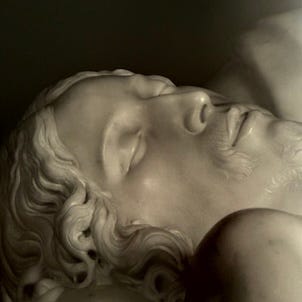
In the detail above, we see the face of Jesus as he lies across Mary’s lap. His eyes are slightly open, showing the curved and delicate edges of the eyelids as if he were resting half asleep rather than extinguished. His mouth is soft—upper and lower lips relaxed, parted just enough to reveal a hint of teeth. The chin is firm, not slack. There is no strain in the face, no collapse.
By contrast, in death, the eyes flatten and sink into their sockets. The mouth stiffens in its dying position; the flesh loses its tension. Here, we see none of these clues of demise. This is the face of a living man—sculpted by Michelangelo to play the role of Jesus.
One might think the model was a man half-awake, dozing. But Michelangelo rarely worked from live models. He sketched rapid drawings, from memory, and from an unmatched understanding of human anatomy and its dynamics. The dozing man—if there ever was one—and the sculptor, himself have long since died. Yet the Pietà remains fully present in our world.
And that fact raises a quiet but decisive question.
If the face before us is not the face of death, then what, exactly, are we looking at?
This is where the artist completes his work—not by explaining, not by instructing, but by asking something of the viewer. The sculpture does not tell us whether this is the final moment of life or the first stillness after it. It does not resolve the question. The sculpture places itself—gently, inexorably—into our awareness.
And awareness requires an action, look again.
To stand before this face and really see it is already a choice.
Not a theological choice. Not yet a philosophical one. A perceptual choice.
Looking closely, what more do we learn about the man in the stone, the art, and the artist?
We resume our exploration with what the eye can register before interpretation takes over. The human face follows certain patterns. Living flesh holds itself together; dead flesh yields. Eyelids settle differently. The mouth changes. Structure loosens. These are not cultural ideas so much as physical facts—things we recognize long before we have words for them.
Seen in that light, the face before us is curious. The eyes are not closed. The mouth is relaxed, not slack. The chin holds its form. This face does not read as having surrendered to death. That perception alone does not explain the sculpture—but it does invite attention.
And attention, once engaged, naturally turns toward the artist, and his intention.
Michelangelo’s choices here are deliberate, though not explanatory. He does not dramatize suffering. He does not insist on despair. He does not clarify this, the final moment of life, on the edge of eternity. Instead, he holds the moment open. The effect is not confusion so much as creative ambiguity —a pause in which more than one meaning is possible at the same time.
This may be what gives the sculpture its unusual staying power. It approaches the story from the moment of anticipation. It does not settle the story for us, instead we see it happening. It is the story of the man, Jesus on the brink of meeting his destiny. To the atheist, it is his death. To the Christian, it is God the Son, and a promise of eternal life. To Michelangelo, both can be simultaneously true. We are looking at it in the process as a great soul leaves the room.
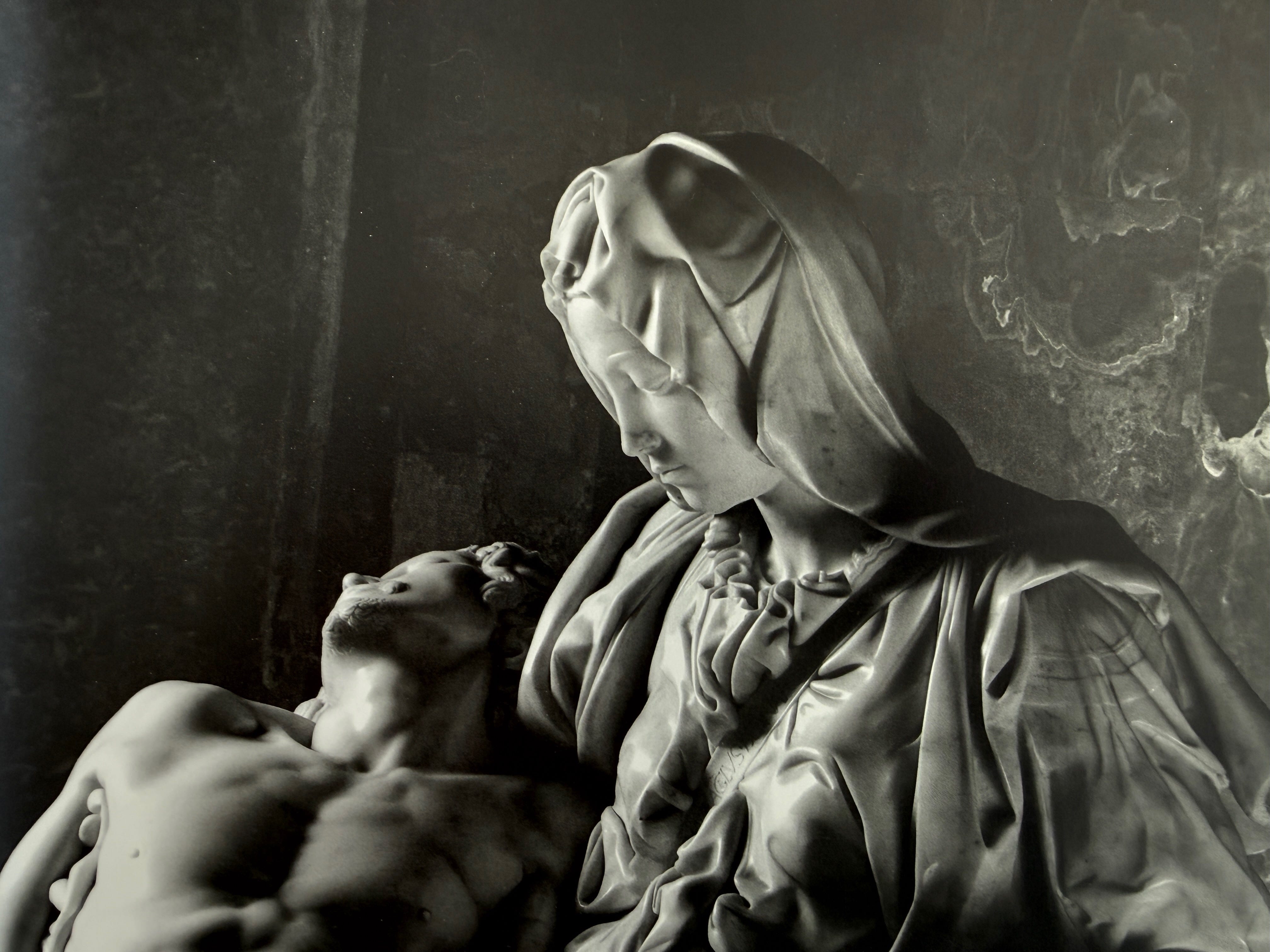
That room matters, especially when we remember the cultural setting in which the Pietà was made. Michelangelo and his audience lived within a world where belief in the Crucifixion and the Resurrection was assumed—taught, reinforced, and required by the Church. The story was already known. The doctrine already established.
And yet knowing a story is not the same as encountering it as a pause on the edge of eternity.
The Pietà does not argue for belief, nor does it illustrate dogma in a straightforward way. Instead, it offers a visual experience that makes belief—whatever one’s relationship to it—feel immediate and human. For some viewers, that experience may deepen faith. For others, it may complicate it. For still others, it may simply linger without resolving into anything definite at all, yet somehow still unforgettable.
Mary’s presence seems central to this effect. We will look closely at Mary in the our third exploration of Michelangelo’s Pietà.
I am not promoting a myth, I am promoting magnificent art which beautifully portrays the human condition, strength in the face of ambiguity. Michelangelo hinted at the myth. He was ahead of his time, and in all art history, he was unique and unequaled in excellence.
This is a fine examination. I believe you are seeing what was intended. Thank You!