


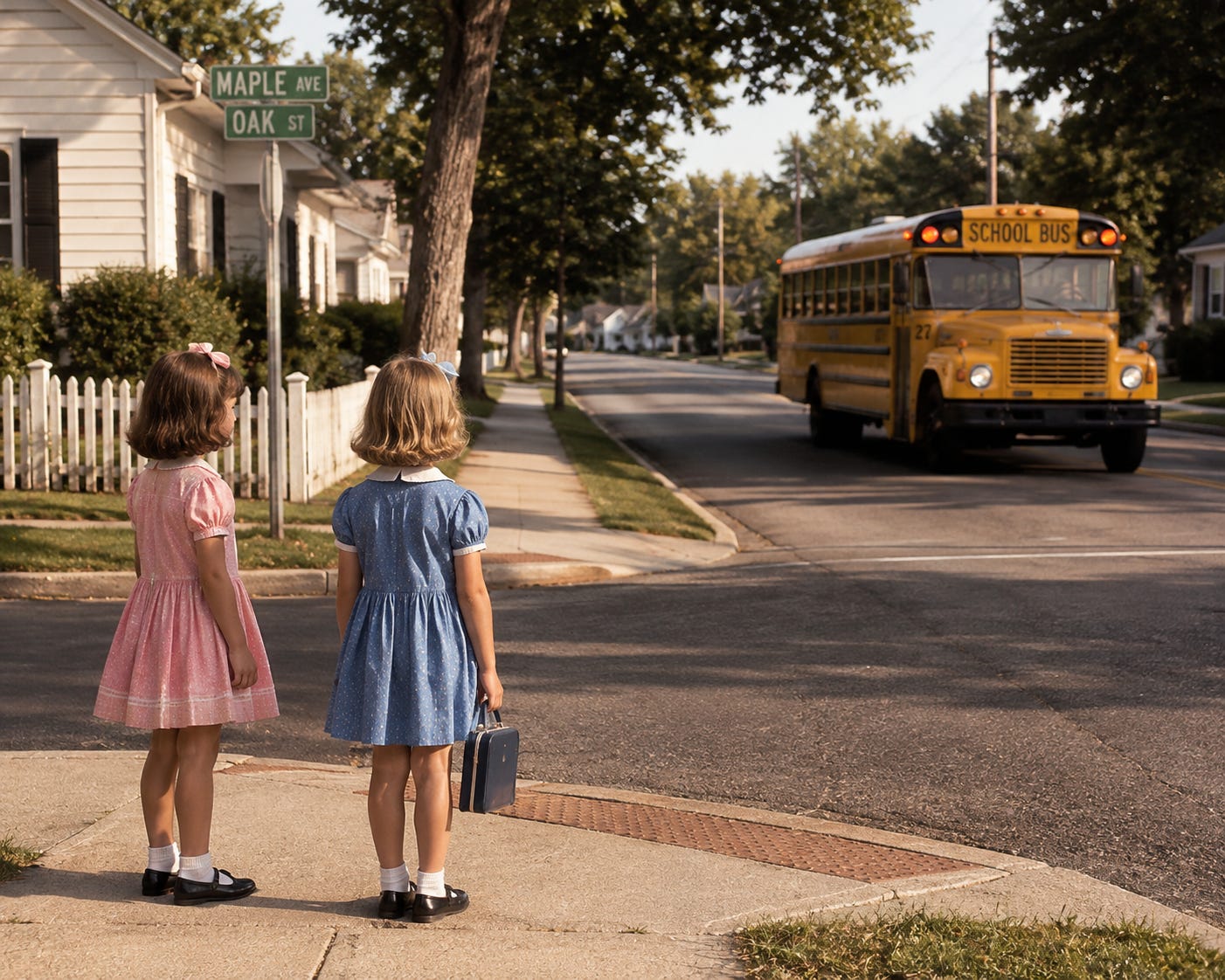
In May of 1953, two first-grade girls were waiting for a school bus at the corner of a quiet suburban street. One girl was new to the area.
The school bus stopped, the door opened, and the new girl started forward. “No!” announced the other girl, palm raised. “This is not your bus,” she declared as she climbed the steps, “You have to wait for the Jewish bus.”
The new girl was surprised and confused. The bus driver called out, “Are you getting on this bus?”
“No, I have to wait for the other bus.”
“Okay,” said the driver. The door closed, and the bus drove away.
After a while, bigger kids came to the bus stop. Another bus showed up. The bigger kids got on that bus. The bus driver asked the little girl why she was there.
“The girl said I had to wait for the other bus, the Jewish bus.”
The bus driver said, “I can’t take you on this bus. I’m going to a different school. Is your mother at home?”
The girl nodded. “Go home and tell your mother what happened.”
Eventually, the new girl got to school, late and humiliated. Her mother talked to the office and the other girl’s parents who lived across the street.
Life settled back to normal, but the definition of normal for the next 11 years was strange: the parents were cordial neighbors, but the two girls were never friends, were never in the same class, and never spoke a word to each other. Perhaps both felt betrayed by something beyond their understanding: the loss of a potential friend to an ancient prejudice.
Antisemitism has been carefully taught for a long time. People ask why. The obvious answer is simply that the Jews are different. Here are some of the differences:
Jewish Belief in God is a Choice: Historically, the Jews were the first people to believe in one God. Acceptance of God has been an individual choice for Jews for millennia. However, Jewish belief in God is sometimes tempered by tradeoffs.
For example, in 1926, Rosie was an illiterate, immigrant widow who asked her in-laws for help. She was rebuffed by her late husband’s family as unworthy. They closed their doors and their hearts.
Rosie earned money sewing piecework six days a week in a sweatshop on New York’s Lower East Side. She learned to count and track her work, to check her boss’s tally of her pay. When a housewife neighbor chided Rosie for working on Saturday, the Jewish sabbath, Rosie retorted, “If God doesn’t want me to feed my girls, I have no use for Him.”
Of course, enthusiastic or authoritarian parents and leaders could and did exert pressure on individuals to accept Judaism, but the individual retained the ability to say no and take responsibility for the consequences, at one time an unthinkable decision in any other religion.
A Secular Jew Is Still a Jew: There are many secular Jews worldwide. Some consider themselves Jews, and some do not. Some are agnostics or atheists. The Bible says that God told the Jews not to seek converts. To believe in the Jewish God is optional, and many self-identified Jews consider Judaism more a cultural system than a system of belief in a mystical deity.
There are four main branches of Judaism:
Orthodox Judaism holds that the Torah (both written and oral law) was revealed directly by God to Moses at Mount Sinai and remains fully binding and unchangeable.
Conservative Judaism views Jewish law as divine and binding, but subject to historical evolution and adaptation
Reform Judaism, the largest branch in North America, emphasizes the evolving nature of the faith and the primacy of individual autonomy.
Reconstructionist Judaism, founded in the 20th century, views Judaism as an evolving religious civilization rather than just a religion. It emphasizes Jewish culture, community, and history.
Jews Value Literacy Highly: All three Judeo-Christian religions teach the Ten Commandments. Over time, many learned rabbis added specific instructions for various rituals and food preparation. Fathers taught their sons to read and understand Hebrew. Thus, by the time of Christ, the Jews already had a 2,000-year-old history and cultural emphasis on the intergenerational transmission of knowledge through reading and study. From 500 CE, Jewish male literacy was drastically higher than in non-Jewish populations.
Around 1180 CE, Maimonides, an esteemed rabbi, scholar, and physician to Saladin in Egypt, published an organized catalog of the rituals called the Mishnah Torah. These laws included community practices for offerings and ritual food. Literacy for Jewish males was nearly universal by the early Middle Ages. After years of study, the ceremonial Bar Mitzvah is a rite of passage marking the transition from childhood to adulthood, on a boy’s thirteenth birthday. Jewish girls gained access to literacy in the 1800s.
Jewish law includes many dietary and ritual laws. As each new generation was taught to prize, understand, and uphold the laws by choice, some were asked to gain the ability to read, understand, and teach the laws to the next generation.
Reading was also prized as access to medicine and history. Preparing ritual meals is a process in which all family members could play a role. Participation in the process was a joy for the children and a joy for the parents to see their children’s joy. Thus, respect for the written word was prized by all, even those who remained illiterate.
Jews Treasure Rituals: The most detailed instructions were for foods prepared as offerings. Grain offerings were made with fine flour, oil, and frankincense. Unleavened cakes and wafers were mixed with or anointed with olive oil. Instructions on roasting, boiling, or baking certain offerings included:
The Passover meal – Roast the lamb whole over fire. Eat it with unleavened bread and bitter herbs. Do not boil it. Do not leave leftovers until morning.
Ordinary food laws – Do not eat blood. Do not eat certain animals. Do not boil a young goat in its mother’s milk (the verse that later became the basis for separating meat and dairy in Jewish law).
Survival under threats and hardship: Second only to the individual life is the necessity to preserve Jewish identity, traditions, and community in the face of exile, persecution, and dispersion. A Jewish God with no Jews would be forlorn. Ancient Judaism had no afterlife, only one’s own Life. The Jews toast to Life, L’chaim, not to fun, God, or death.
The primacy of Life remains, even in death. Mourners may treasure the memory of the deceased as a personal gift for their own future, with sorrow, gratitude, and enduring inspiration.
Justice is a personal responsibility: A central ethical ideal of Judaism emphasizes fairness and equality under the law based on the actions of the individual. Actions are worthy and responsible or unworthy and irresponsible, and judged accordingly. Even though Jewish thought added a hazy afterlife in the 6th century BCE, the Jew is expected to right his or her wrong personally in this life and not expect to pay for the wrongs in a mythical afterlife.
Tribalism by Choice: Tribalism is usually thought to be a mechanism of involuntary membership, but these days, people who form loose associations of friends and relatives sometimes call themselves a tribe. That new kind of tribe is both voluntary and optional in every way.
Many people believe that tribalism is always maintained by force or fraud. Some religions maintain themselves by myths. Even for some religions today, choice is one-way; if you opt in, you cannot opt out, except by becoming apostate. The Jews themselves are proudly tribal because the Jewish “tribe” is different; it is chosen and can be abandoned if the choice doesn’t fit the individual’s expectations.
Moreover, a “tribe” of well-read, articulate, and thoughtful people has significantly higher brain power than a mob of barbarians whose highest goal is to die for a mystical God.
Individualism: Judaism embodies a tradition that values personal moral responsibility, a clear conscience, honesty, learning, and accountability both within a community and, more importantly, for one’s own self-respect, self-esteem, and peace of mind. The Bible says, "Be fruitful and multiply." The Jews consider themselves a community of individuals.
The irony of these traits that the Jews prize is that they are the foundation of Western Civilization, which is also under attack by people who want the rewards of knowledge and industry without the philosophy of individual freedom of choice that achieves human thriving and keeps it fresh and dynamic.
You may still ask which one is the real reason for antisemitism? It could be these or something not even mentioned. Antisemitism is as ancient as the Jews. The Jews have learned to cope. The Israelis have learned to fight, as they must.
Humor is one way to cope with hardship and barbarism, preserving perspective and strengthening family and community through shared experience, especially through storytelling. There is an old saying: two Jews, three opinions. In practice, every opinion usually comes with an explanation, that is, a story. The Jews have used their cultural fluency to be funny, often ironic, disagreeable, and proud of being disagreeable. To be disagreeable with humor is a prized art. Thus, a Jew could correctly say that the Jews are different and proud of it.
Rosie was my grandmother, and I called her Nanny. We lived in her apartment in the Bronx. My mother knew everything and read to me, but Nanny was pure joy. We’d have adventures, and she’d say, “Don’t tell your mother.” At any gathering of strangers, Nanny had the knack of turning shy strangers into happy people eager to know each other.
Nanny understood the ways of hatred from the pogroms of Europe to the sidewalks of New York. On August 13, 1961, a news report on TV showed workmen building a wall in East Berlin. Nanny and I watched together. Nanny’s lips got tight, and she said under her breath, “It’s starting again.”
“Nanny, why do people dislike Jews?”
She shook her head, “They’re just jealous.”
When emotion takes hold, reason is irrelevant. She died later that year, and a light went out in my world. When the Berlin Wall came down in 1989, I knew she would have been pleased.
Now antisemitism is on the rise again. Is there an answer?
"They're just jealous" is still the best explanation of anti-Semitism I have heard.
Wow, I had no idea. I knew only the smallest bits and pieces of what Judaism was/is. This opened my eyes to what that culture is like, and it is mostly wonderful. If I wasn't an atheistic Objectivist, I would be a Jew.